

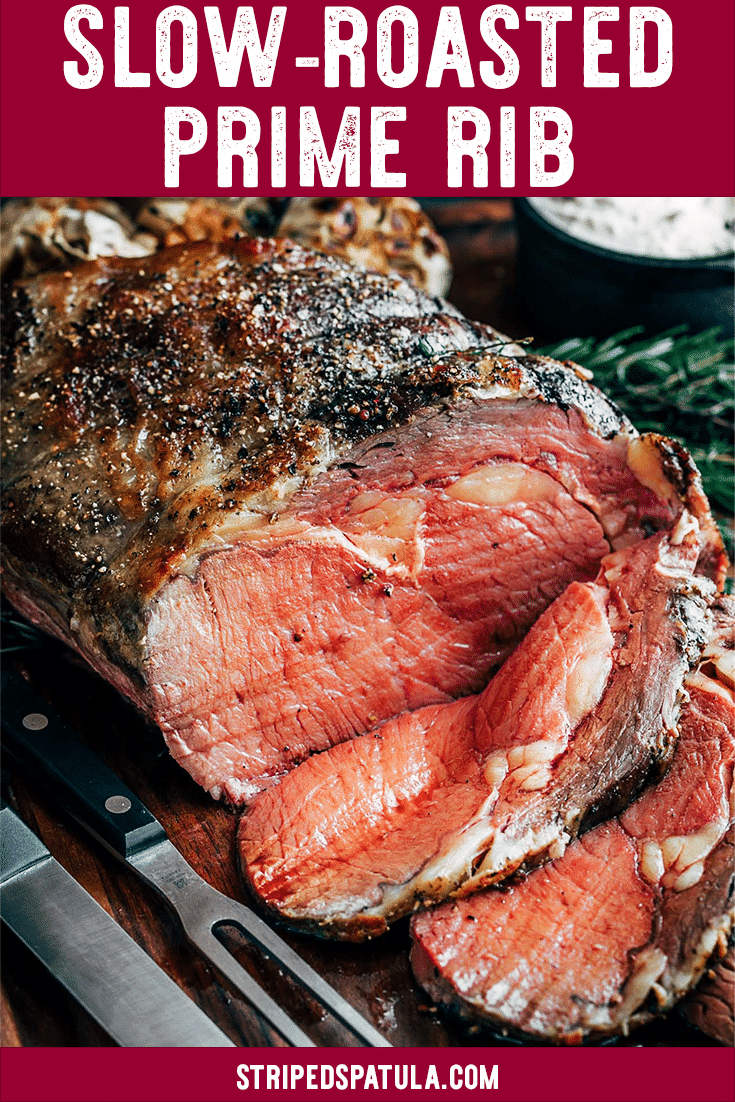
This tender Slow Roasted Prime Rib is the perfect centerpiece for a holiday dinner. Using a reverse-sear method creates a juicy and tender roast with a crisp outer crust.
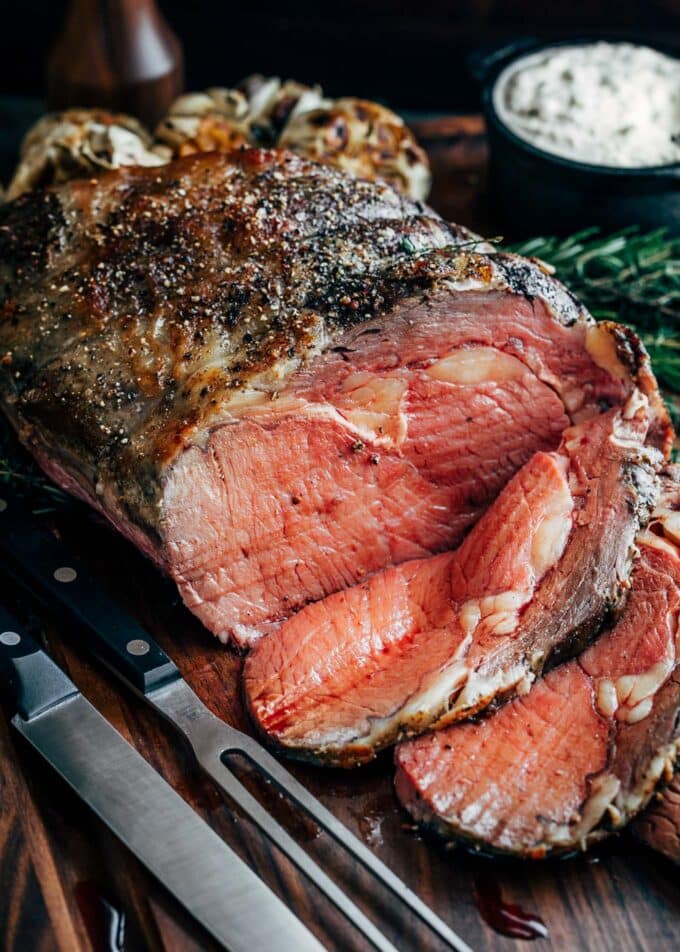
There are few entrees more impressive than Slow Roasted Prime Rib for a holiday dinner. A perfectly-cooked standing rib roast, carved into juicy, rosy slices, makes a gorgeous presentation on a carving board or platter. Prime rib has become a luxurious yearly Christmas tradition for many families.
Given that prime rib can be costly, there can be a lot of pressure to get the cooking process “right.” Today, I’m sharing my shopping tips and preferred method for making an unforgettable slow roasted prime rib that will leave your guests coming back for seconds every. single. time.
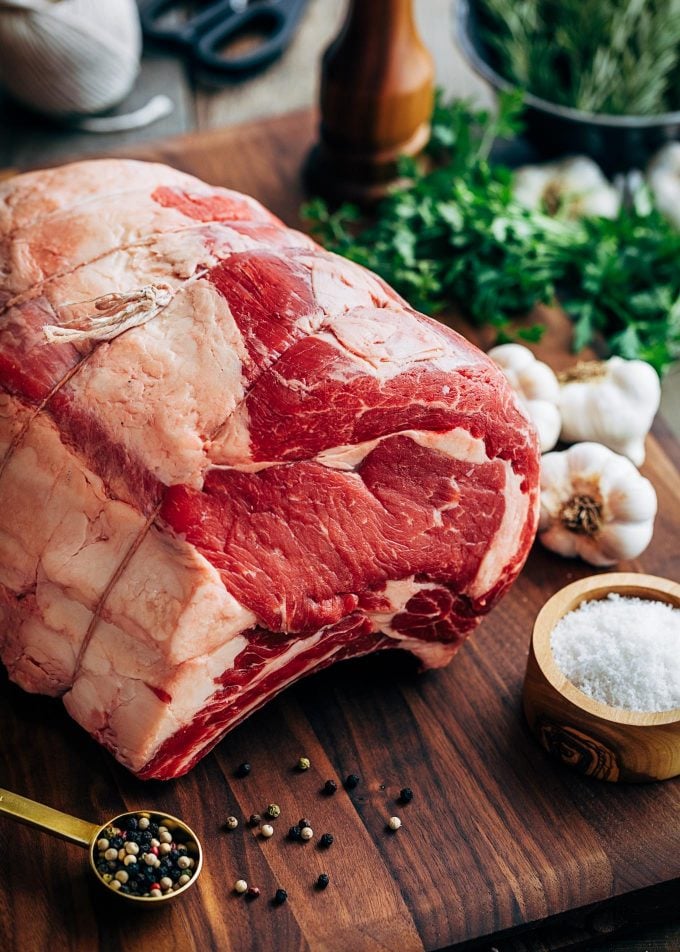
What exactly is Prime Rib?
Prime rib (also known as “standing rib roast” when sold on the bone) is beef cut from the rib section; more specifically, ribs 6 to 10. This is the area where ribeye steaks originate. It’s meaty, well-marbled, and utterly delicious.
You can buy boneless prime rib, but I much prefer roasting on the bone for the best flavor, juiciness, and texture. Want to delve further into prime rib cuts? I love The Food Lab’s Definitive Guide to Prime Rib over at Serious Eats.
Shopping for Prime Rib
Is all Prime Rib Prime-Grade Meat?
Despite being known as “Prime” rib, this cut does not necessarily carry the USDA Prime grading. You can buy Prime Rib as USDA Prime or Choice. Marketed at a higher price point, a Prime-grade rib roast will be more marbled than Choice, improving flavor and texture.
(I love Prime-grade roasts, and even better, those that have been dry-aged. That said, I’ve also had many Choice-grade cuts that have been absolutely delicious. Especially when utilizing the reverse sear method described below.)
How should I ask for the prime rib to be cut?
When I buy prime rib, I like to ask the butcher to cut the roast from the loin end of the rib section (also known as the “first cut”), as opposed to the chuck end (the “second cut”). This is a personal preference; the loin end is typically a bit less fatty (though, still well-marbled) and more tender.
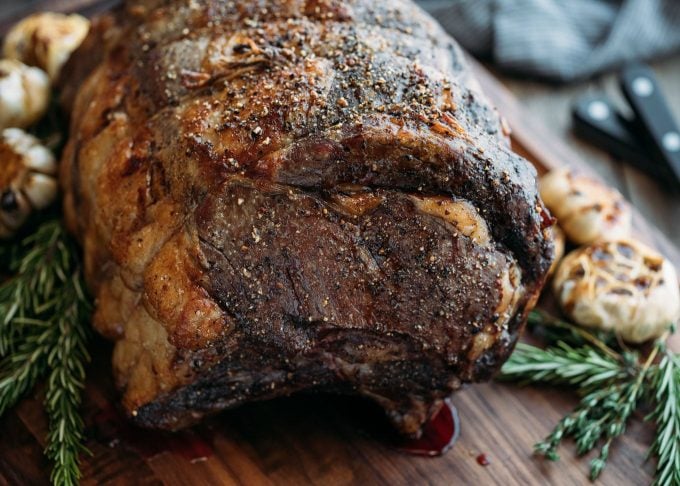
To make serving easier, I also ask the butcher to cut the meat off of the bones and tie it back on for roasting, as has been done here. When ready to serve, just snip away the twine, lift the meat from the bones, and carve.
How Much Prime Rib Should I Buy?
As a general rule, I plan on 1 pound per person when buying prime rib on the bone. You can expect to serve 2 adults per rib.
What is the Reverse Sear Method?
Many traditional prime rib recipes call for searing the meat either on the stove or in an ultra-hot oven to create an outer crust before slow roasting. The “Reverse Sear” method flips the process, first slow roasting the meat at 250 degrees F to your desired internal temperature. The meat is then rested and seared at 500 degrees F just for a few minutes before serving.
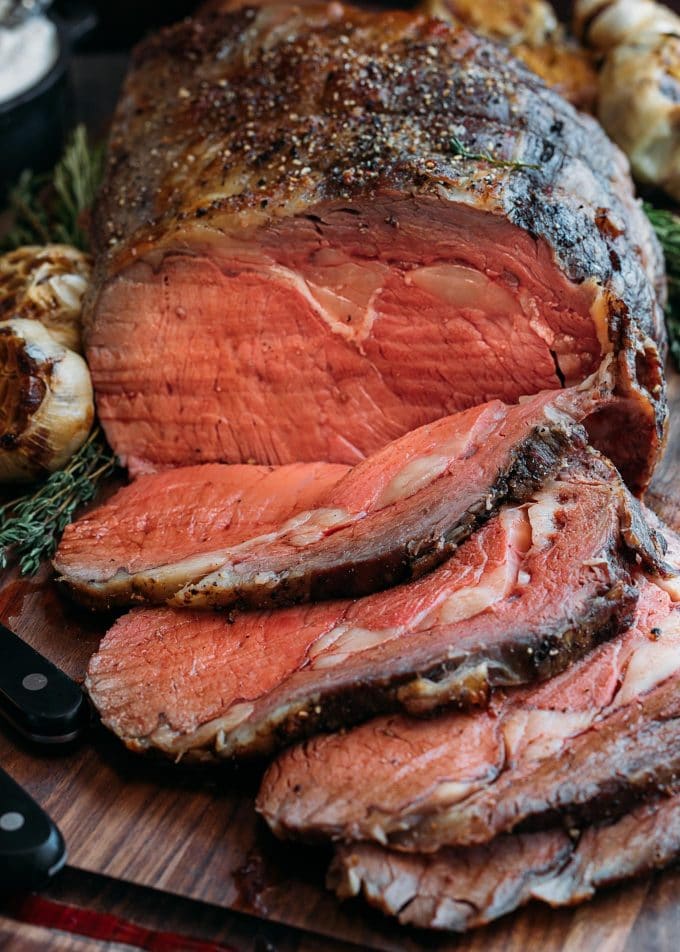
What’s the benefit to utilizing a reverse sear? The meat is incomparably tender and evenly cooked from end-to-end with a minimal area of overcooked “gray ring” on the interior.
Slow roasting the raw meat in a 250-degree F oven also results in less moisture loss. All of the drippings that are usually released into the pan with a high initial (or prolonged) cooking temperature remain in the roast. Slices of prime rib cooked with the reverse sear process are so juicy.
Beautifully crusted, rosy, juicy meat throughout the roast? Talk about the perfect prime rib!
Want to read more about reverse searing? Check out two of my favorite articles from Serious Eats and Bon Appétit.
How Should I Season Prime Rib?
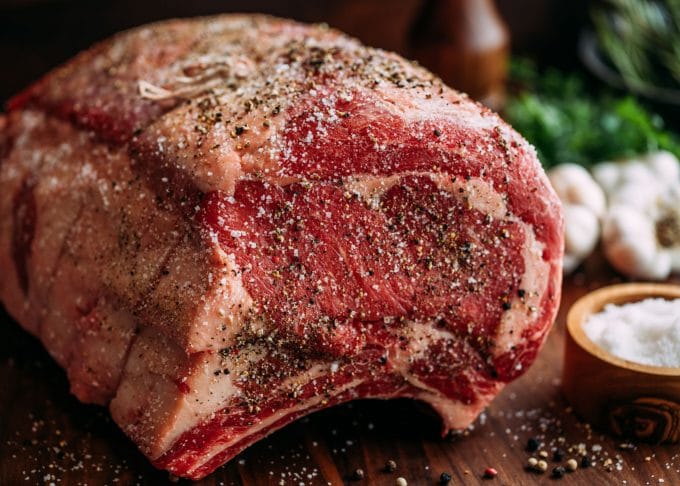
I like to keep it simple with a generous coating of sea salt and freshly-cracked black pepper. To encourage a great crust, I season the meat the night before roasting, and let it stand uncovered in the refrigerator to dry a bit.
How Should I Serve Slow Roasted Prime Rib?
I love a good sauce, a potato side dish, and a green vegetable with a slice of prime rib.
If there’s any potential drawback to cooking a prime rib with a reverse sear, it’s the lack of drippings to make a pan sauce. Since all of those juices remain in the meat as it cooks, there isn’t much to work with in the pan afterwards.
By the same token, reverse-seared meat is so juicy, you don’t really need a pan sauce or jus.
I like to serve this prime rib with a complementary condiment, such as my Roasted Garlic and Horseradish Cream Sauce, and Duchess Potatoes. Creamy horseradish sauces are a classic pairing with prime rib, and go especially well with the tender meat.
Don’t forget the leftovers!
If you’re lucky enough to have leftover prime rib after a holiday dinner, it makes fantastic roast beef sandwiches, breakfast hash, or even Pho. This is a roast that you’ll want to make the absolute most of after the holiday!

Slow Roasted Prime Rib
Ingredients
- 6 to 12 pound standing rib roast (bone-in prime rib)
- kosher or sea salt
- freshly-cracked black pepper
- Roasted Garlic Horseradish Cream Sauce (optional, for serving)
Instructions
- For ease in carving, ask your butcher to cut the meat off of the ribs and chine (backbone) and tie it back on.
- The day before you plan to roast your prime rib, season it liberally on all sides with salt and pepper. Place the roast on a heavy baking sheet with the fat cap side up and refrigerate, uncovered, overnight (or up to 24 hours).
- Remove the prime rib from the refrigerator and let stand at room temperature for 2 hours before roasting.
- Preheat oven to 250°F with the rack in the lower third of the oven. Place prime rib on a v-rack in a roasting pan with the fat-cap side up.
- Roast until an instant-read thermometer inserted into the thickest part of the meat (away from the bone) reads 120-125°F for rare, 128-130°F for medium-rare, or 132-135°F for medium and medium-well. This will take 3-4 hours.
- Remove the prime rib from the oven, tent with foil, and let rest for 30 minutes.
- Increase oven temperature to 500°F. Uncover the roast and sear it in the oven for 5-10 minutes, until the exterior is brown with a crisp crust.
- Carve the prime rib and serve with Roasted Garlic Horseradish Cream Sauce on the side.
Notes
Oven Calibration
Especially when slow roasting at a low temperature, it’s important to confirm that your oven is running true to temperature with a reliable oven thermometer before you get started. Read how to test it with this article from Fine Cooking.Nutrition Estimate
Nutrition information is automatically calculated, so should only be used as an approximation.
Please note that our recipes have been developed using the US Customary measurement system and have not been tested for high altitude/elevation cooking and baking.
You may also like:

Main Dishes
One Pan Ground Beef Stroganoff
Air Fryer
Air Fryer Chicken Fajitas
Air Fryer
Air Fryer Breaded Pork Chops
Main Dishes










This became our Christmas dinner instead of a turkey. This is our third year! Perfect dinner for short trip to my parents. I can cook and take it to my their house and finish with the last sear and ready to eat. Also, much less hassle than preparing a turkey dinner. Thank you for sharing.
Oh, my gosh!! This was my first attempt and thanks to this recipe, I knocked it out of the park!! Cooking is NOT my thing but tonight I feel like a culinary rock star!! An 8.5 lb roast with a $70 price tag (the smallest I could find) made me incredibly nervous and I didn’t want to get it wrong! Well, it was perfect! Good thing, too, because, here in 2020, there are only 3 of us to eat it! Not a problem, at all. Thank you so much for this technique. I can hardly wait to see what else I can use it for.
I have never in my life (and that is many, many years) made a prime rib until this Christmas Eve, 2020. Your recipe and directions made it so easy and it turned out perfect. Thank you, Merry Christmas and Happy New Year!
Best Rib Roast ever! Served with a Merlot Au Jus as we aren’t fussy on horseradish, and everyone raved about how delish this dish is! Planning a day ahead and having a dinner so rich and delicious with such simplicity, thanks for sharing!!!!
Okay, followed the recipe to a T and I have to OMG. Restaurant quality. Super juicy, medium rare through and through. A definite keeper!!!
Turned out fantastic! Will use this recipe often! Tender, juicy, Great eye appeal, my husband was impressed.
Would add a picture but I dont see a tab for that.
Hi Lisa, we’re so glad to hear the Prime Rib was a hit! If you have a public profile on Instagram, we’d love for you to share your photo with us, tagging #stripedspatula and @stripedspatula. Happy Cooking!
This recipe and technique sound amazing. Will it work on a grill?
Hi Yvonne, I’ve never tested it on a grill, so unfortunately, I wouldn’t be able to say with certainty!
Everyone says they sear at 500 degrees but for someone who never cooked a Prime Rib can you tell me how long you sear it for?’
Hi Dottie, sear it for 5-10 minutes (step 7 in the recipe).
I made this for dinner last night and it came out perfect. Forgot to take a picture but it was beautiful! Thank you for your recipe!
Hi Mary, I am so glad you enjoyed it! Happy Holidays!
Hi Amanda,
If cooking at 250 degrees for 8lbs, roughly how long will that take for to reach 125 temp?
Thanks
Anxious James
Hi James,
You’ll be looking at 3 to 4 hours for the slow roast portion. Be sure to rest the meat at room temp for 2 hours before it goes into the oven to take off the chill from the refrigerator. (Don’t be anxious! Make sure your meat thermometer is giving accurate readings before you get started and it’ll turn out great!)
The Prim Rib was the star of dinner. The receipe was simple and your thermometer readings for medium-well made for a tender not so bloody main course–lots of pink and no gray.
I appreciate this reverse method, as the color and glaze offered delectable eye-appeal. Thank you.
Great recipe. Couldn’t have been better. Thank you! I’ll never do it any other way.
Amanda: just wanted to tell you I think you’re technique rocks! Also tell you and others that, by a happy accident, you can dry age a standing rib roast in the deep freezer, with care. My husband lost his partial denture at Valentine’s Day, and I had to try and save this $60 roast. I wrapped it in several layers of plastic wrap, then several layers of heavy duty foil, then in a freezer bag. Until Christmas. Let it thaw in the frig for 10 days. I was nervous as I then unwrapped it…it was beautiful. Had just shrunk a bit, but no ice crystals or freezer burn. Did a dry brine, then a slow roast. Best standing rib roast ever! Thanks for your recipe
This is absolutely the best way to cook prime rib! The dry brine technique is the way to go. Now I’m in charge of all prime rib get togethers. So easy!
It’s how I cook prime rib exclusively, follow it to the letter. Perfect every time!!
Wow what a wonderful recipe, not only the best I ever cooked but also the best I ever had.