

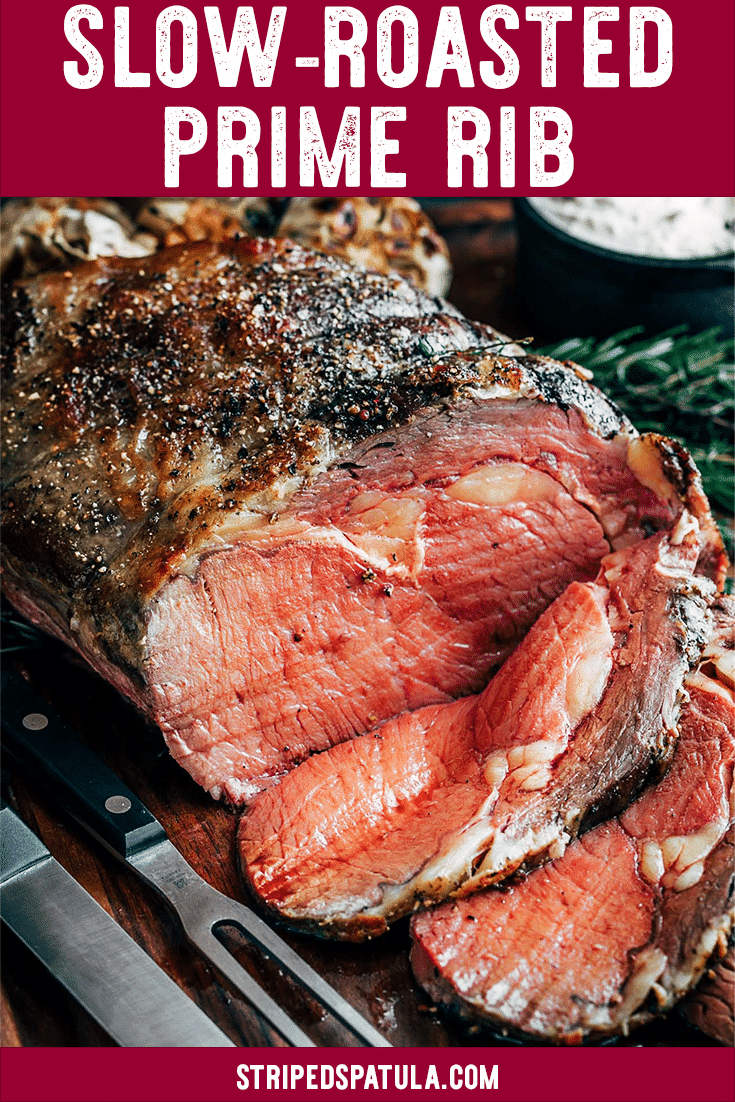
This tender Slow Roasted Prime Rib is the perfect centerpiece for a holiday dinner. Using a reverse-sear method creates a juicy and tender roast with a crisp outer crust.
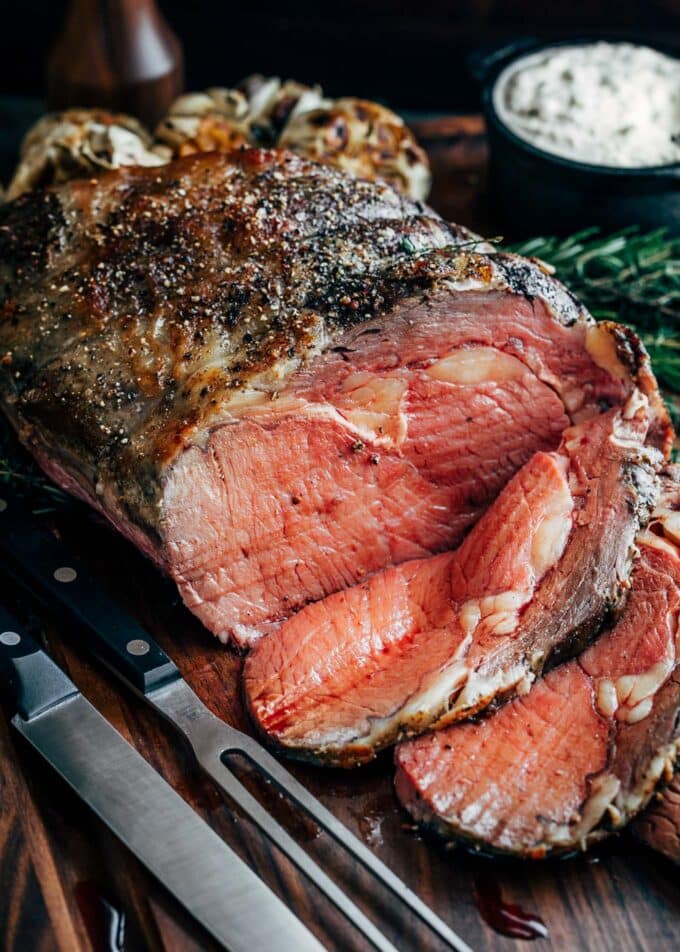
There are few entrees more impressive than Slow Roasted Prime Rib for a holiday dinner. A perfectly-cooked standing rib roast, carved into juicy, rosy slices, makes a gorgeous presentation on a carving board or platter. Prime rib has become a luxurious yearly Christmas tradition for many families.
Given that prime rib can be costly, there can be a lot of pressure to get the cooking process “right.” Today, I’m sharing my shopping tips and preferred method for making an unforgettable slow roasted prime rib that will leave your guests coming back for seconds every. single. time.
What exactly is Prime Rib?
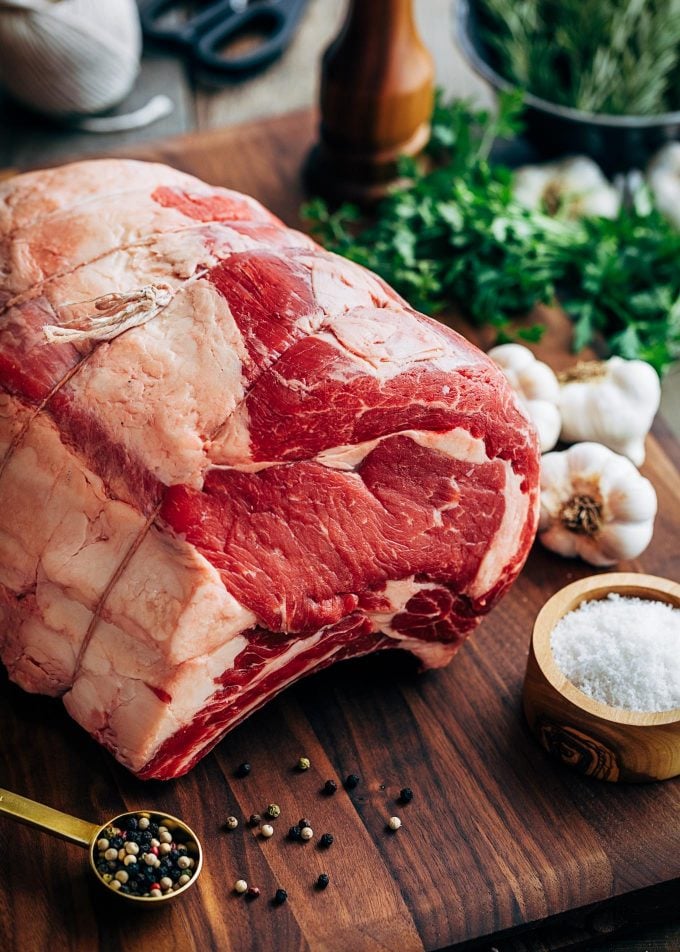
Prime rib (also known as “standing rib roast” when sold on the bone) is beef cut from the rib section; more specifically, ribs 6 to 10. This is the area where ribeye steaks originate. It’s meaty, well-marbled, and utterly delicious.
You can buy boneless prime rib, but I much prefer roasting on the bone for the best flavor, juiciness, and texture. Want to delve further into prime rib cuts? I love The Food Lab’s Definitive Guide to Prime Rib over at Serious Eats.
Shopping for Prime Rib
Is all Prime Rib Prime-Grade Meat?
Despite being known as “Prime” rib, this cut does not necessarily carry the USDA Prime grading. You can buy Prime Rib as USDA Prime or Choice. Marketed at a higher price point, a Prime-grade rib roast will be more marbled than Choice, improving flavor and texture.
(I love Prime-grade roasts, and even better, those that have been dry-aged. That said, I’ve also had many Choice-grade cuts that have been absolutely delicious. Especially when utilizing the reverse sear method described below.)
How should I ask for the prime rib to be cut?
When I buy prime rib, I like to ask the butcher to cut the roast from the loin end of the rib section (also known as the “first cut”), as opposed to the chuck end (the “second cut”). This is a personal preference; the loin end is typically a bit less fatty (though, still well-marbled) and more tender.
To make serving easier, I also ask the butcher to cut the meat off of the bones and tie it back on for roasting, as has been done here. When ready to serve, just snip away the twine, lift the meat from the bones, and carve.
How Much Prime Rib Should I Buy?
As a general rule, I plan on 1 pound per person when buying prime rib on the bone. You can expect to serve 2 adults per rib.
What is the Reverse Sear Method?
Many traditional prime rib recipes call for searing the meat either on the stove or in an ultra-hot oven to create an outer crust before slow roasting. The “Reverse Sear” method flips the process, first slow roasting the meat at 250 degrees F to your desired internal temperature. The meat is then rested and seared at 500 degrees F just for a few minutes before serving.
What’s the benefit to utilizing a reverse sear? The meat is incomparably tender and evenly cooked from end-to-end with a minimal area of overcooked “gray ring” on the interior.
Slow roasting the raw meat in a 250-degree F oven also results in less moisture loss. All of the drippings that are usually released into the pan with a high initial (or prolonged) cooking temperature remain in the roast. Slices of prime rib cooked with the reverse sear process are so juicy.
Beautifully crusted, rosy, juicy meat throughout the roast? Talk about the perfect prime rib!
Want to read more about reverse searing? Check out two of my favorite articles from Serious Eats and Bon Appétit.
How Should I Season Prime Rib?
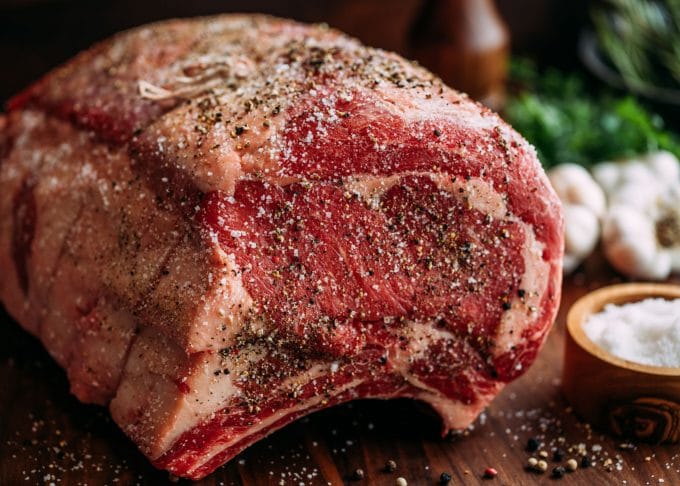
I like to keep it simple with a generous coating of sea salt and freshly-cracked black pepper. To encourage a great crust, I season the meat the night before roasting, and let it stand uncovered in the refrigerator to dry a bit.
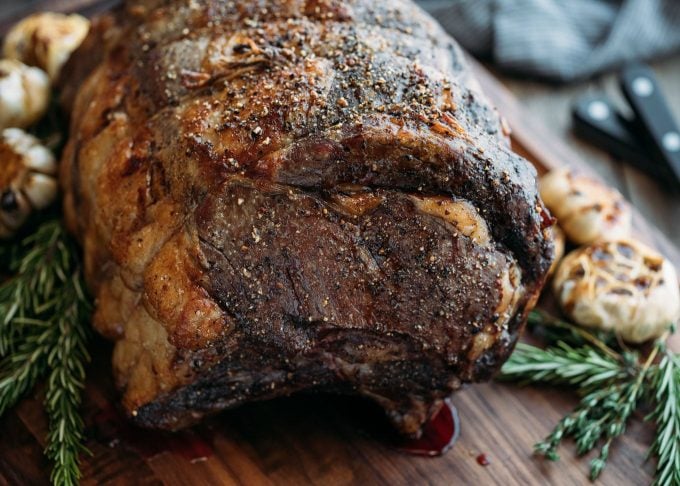
How Should I Serve Slow Roasted Prime Rib?
I love a good sauce, a potato side dish, and a green vegetable with a slice of prime rib.
If there’s any potential drawback to cooking a prime rib with a reverse sear, it’s the lack of drippings to make a pan sauce. Since all of those juices remain in the meat as it cooks, there isn’t much to work with in the pan afterwards.
By the same token, reverse-seared meat is so juicy, you don’t really need a pan sauce or jus.
I like to serve this prime rib with a complementary condiment, such as my Roasted Garlic and Horseradish Cream Sauce, and Duchess Potatoes. Creamy horseradish sauces are a classic pairing with prime rib, and go especially well with the tender meat.
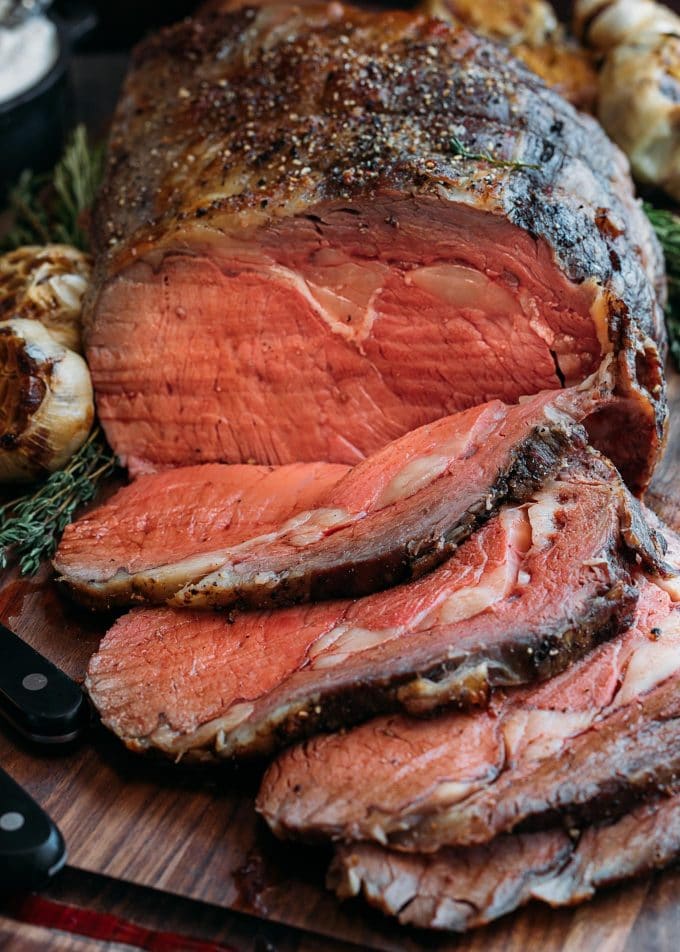
Don’t forget the leftovers!
If you’re lucky enough to have leftover prime rib after a holiday dinner, it makes fantastic roast beef sandwiches, breakfast hash, or even Pho. This is a roast that you’ll want to make the absolute most of after the holiday!

Slow Roasted Prime Rib
Ingredients
- 6 to 12 pound standing rib roast (bone-in prime rib)
- kosher or sea salt
- freshly-cracked black pepper
- Roasted Garlic Horseradish Cream Sauce (optional, for serving)
Instructions
- For ease in carving, ask your butcher to cut the meat off of the ribs and chine (backbone) and tie it back on.
- The day before you plan to roast your prime rib, season it liberally on all sides with salt and pepper. Place the roast on a heavy baking sheet with the fat cap side up and refrigerate, uncovered, overnight (or up to 24 hours).
- Remove the prime rib from the refrigerator and let stand at room temperature for 2 hours before roasting.
- Preheat oven to 250°F with the rack in the lower third of the oven. Place prime rib on a v-rack in a roasting pan with the fat-cap side up.
- Roast until an instant-read thermometer inserted into the thickest part of the meat (away from the bone) reads 120-125°F for rare, 128-130°F for medium-rare, or 132-135°F for medium and medium-well. This will take 3-4 hours.
- Remove the prime rib from the oven, tent with foil, and let rest for 30 minutes.
- Increase oven temperature to 500°F. Uncover the roast and sear it in the oven for 5-10 minutes, until the exterior is brown with a crisp crust.
- Carve the prime rib and serve with Roasted Garlic Horseradish Cream Sauce on the side.
Notes
Oven Calibration
Especially when slow roasting at a low temperature, it’s important to confirm that your oven is running true to temperature with a reliable oven thermometer before you get started. Read how to test it with this article from Fine Cooking.Nutrition Estimate
Nutrition information is automatically calculated, so should only be used as an approximation.
Please note that our recipes have been developed using the US Customary measurement system and have not been tested for high altitude/elevation cooking and baking.
You may also like:

Main Dishes
One Pan Ground Beef Stroganoff
Air Fryer
Air Fryer Chicken Fajitas
Air Fryer
Air Fryer Breaded Pork Chops
Main Dishes










I used this recipe for my sons-in-law birthday dinner last week. I baked an eight pound roast (boneless) using a seasoning mix provided by the meat market. It turned out awesome; tender, juicy, and was ready to serve at the exact time I hoped it would! I’ll be using this recipe from now on. This recipe is great, thanks so much!
Hi Amanda,
I do a prime rib every year for family and friends. I really want to try your slow-cook method this time; I have a 10.5lb 5-rib roast and we plan on eating at 5:30 pm.
What time would you recommend I place the roast in the oven to hit my serve time?
Thanks!
Tim
Hi Timothy,
Thanks for your question. As noted in the recipe, the slow roasting process will take 3-4 hours in addition to the rest time and final sear.
Happy Cooking,
The Striped Spatula Team
All I can say is WOW! I had given up on prime rib roasts as we have always overcooked them and been disappointed. Vons had a big sale on prime rib roasts this year and my husband insisted that try again. Reluctantly I agreed. When I came across your instructions I decided to give it a try. My husband, meanwhile, was looking through all of the cook books and he tried to get me to cook it on the higher heat. I told him no, we’ve tried it that way and overcooked it every time. We need to try something new and if this doesn’t work, that’s it, we’ll quit wasting our money! We cooked a 5-lb roast at 250 degrees. It took 3 hours to get to 122 degrees. I let it rest the 30 minutes and popped it back into the 500 degree oven afterwards. It was pink from edge to edge, with just a little extra rare in the very center. Perfect and foolproof! Thank you so much!
I followed your instructions and christmas eve dinner was awesome for all 8 of us thank you for sharing
Wow, Amazingly simple. My sister cooked prime rib years ago and it came out grey so was always hesitate with a $100 holiday investment. This year did the reverse roast one -4 lbs to 125 and a 2 bone-in (4 lbs) to 135. Salt, pepper, thyme, parsley and garlic pressed/ rub. Results 4 end cuts 4lbs med rare and 4 med. Amazingly juicy, drained grease and pan scraping were perfect for au-jue with some beef broth added. Don’t forget horseradish sauce and sour cream. Dinner for 15. Many recepies get confusing. This was simple clear; trust your oven thermometer not the clock. Rested 1 hour enroute to party and seared at 500 once there. Perfection!
Does cooking in 200 or 250 degrees make a mess of grease in the oven
Hi Carm, the slow roast hasn’t ever caused a mess in my oven.
Tried many other recipes…this one is now my favorite. The juiciest rib roast I have ever had. Thank you. 5* :)
Used this method yesterday (Christmas) and it was just outstanding. I got rave reviews. One tip when you do the high sear if using a convection oven 7 minutes was more than enough. Now on to the breakfast hash recipe.
Just followed this for an 8lb cut. Except I had the oven at 225 instead of 250. It was incredible. Thank you for all the tips!
So tender – this recipe is the way the entire family will cook prime rib going forward. The night before we sprinkled the roast with Worcestershire sauce and then added a dry rub of sea salt, pepper, onion and garlic powders, paprika, and wrapped it tight in plastic wrap and put it in the fridge. Otherwise followed the recipe exactly. Who knew a prime rib would cook this delicious at 250 degrees?! Thank you for a wonderful meal.
Just cooked our 6.5 lb prime rib roast this way today for Christmas. I wanted to try something different because using the traditional method where cranking up the heat first thing about smoked us out of house and home last year. Smoke alarms were going off, house filled with smoke, windows open in the middle of winter…and it is a cardinal sin to open the oven using the traditional approach. So there wasn’t much we could do, other than bare the misery. This version cooking with low temps initially and saving the high temp cooking for the end helped with that issue. And…the meat turned out really good. Saving this recipe! Thanks for posting it.
I just tried this recipe for Christmas dinner today. Wow! I will always use this method. It was as you said, juicy inside and crisp on the outside. Thank you.
Tried this last night. Best boneless roast we’ve ever had.
Cooked at only 200 degrees for 30 min/Lb. then removed from the oven at 130 internal temp. Turned oven to 550. When at temp, seared for 10 minutes.
Served immediately after removed.
The nice thing is that you can let it rest for up to 1 hour before searing to allow for slow eaters or other delays.
Medium Rare from edges to center!!
Hey I am wanting to use your recipe for Christmas dinner this year. I have a convection oven with an optional traditional bake setting. Should I use the traditional bake or go with the convection features? I think I will probably do the sear on convection but as for the slow bake…?
I am using a boneless rib roast… do you have an idea of the timing? Just trying to timeline my cooking.
Thank you so much!
Hi Marissa, I tested this one on the regular bake setting of my oven to accommodate the most readers. Convection will definitely give it a great sear at the end! Just keep an eye so it doesn’t burn. My convection cooks about 25% faster than my bake setting. A boneless rib roast typically takes a little less time, though I haven’t tested the reverse sear method with boneless, as we always buy bone-in. Merry Christmas!
I notice that the “slow roasting” temps from many sites recommend a 200 degree cook…yours is at 250. The meat has a shorter cooking time, but is there any other reason to cook it at 200 degrees? Big difference.
Hi Patricia,
Technically speaking, a 200 degree F oven is considered a “cool oven.” 250 is “very slow.” In my experience, 250 is warm enough to tenderize the meat the best, with the benefit of a slow roast. (Also, not all ovens can maintain a consistent heat below 250.) It’s the temperature most often recommended in reverse sear methods. Thanks for visiting!